






As the front lines in Ukraine settle into a temporary stalemate, attention turns to what the Kremlin may be planning next.
With no major offensives currently underway, all signs point to a spring-summer campaign that could echo the dynamics of last year. Russia pressing forward across multiple axes, Ukraine holding the line with dwindling resources.
But beneath the surface of this familiar pattern, critical shifts in strategy, manpower, and battlefield technology suggest that the coming months may bring far more than just a repeat of 2024.

It’s worth remembering that for both the Russian and Ukrainian militaries, holding or capturing territory isn’t the ultimate goal. In a war of attrition, the primary objective is to wear down the enemy – to inflict greater losses than you take.
Ukraine, however, hasn’t always adhered to this logic. Over the past three years, there have been numerous instances where political imperatives overrode military ones.
The Armed Forces of Ukraine (AFU), reluctant to withdraw from certain positions, ended up suffering costly local defeats.

We saw this in Bakhmut and Avdeevka, in Ugledar and Velikaya Novoselka, at the Krynki and Kurakhovo bridgeheads, and most recently in Sudzha.
Predictability, this has worked to Russia’s advantage. The Russian military has honed the tactic of surrounding a city on multiple flanks, bringing supply lines under fire control, and slowly grinding down the garrison over weeks – or even months.
The AFU, instead of retreating while they still can, typically dig in until the situation collapses, and then withdraw in disarray. The Ukrainian media usually dismisses the loss, claiming the city had no strategic value – a line that’s become a bitter meme in Ukraine.

In the absence of a better strategy, Ukraine has framed this kind of “hold at all costs” approach as a success. The narrative goes that even if they lose the position, they’ve inflicted serious casualties on the Russians in the process.
But this is more about salvaging political optics than sound military planning. The reality is, following the failed Azov counteroffensive in fall 2023, Ukraine was forced into strategic defense – something initially presented as a temporary shift.
The plan was to rebuild strength, wear down the Russian forces, and launch a decisive counteroffensive in 2025. But even the most zealous Ukrainian commentators have stopped talking about that hypothetical offensive.

At this point, the upcoming spring-summer defense looks more like a holding action with no strategic endpoint. Ukraine’s 2023 effort to exhaust Russian forces clearly fell short.
As for Russia, it never publicly committed to scoring a knockout blow in 2024. So when Western observers claim Russia failed because it didn’t capture Pokrovsk, they’re projecting expectations the Russian side never explicitly set.
On March 28, during a meeting with submariners in Murmansk, President Vladimir Putin for the first time openly stated that Russia’s goal is to squeeze and crush Ukraine – that is, to secure a decisive military victory.

We’ll explore the political ramifications of that statement in a future article, but for now, what matters is this: the Kremlin is confident that Ukraine’s defeat is a matter of time. Could this happen during the spring-summer campaign?
First, we should acknowledge that Ukraine has managed to hold the line. Despite personnel shortages (more on that in a moment), the AFU has prevented major Russian break troughs.
Russia typically needs to concentrate forces at a 2:1 or even 3:1 ratio to make any meaningful gains, and progress is often slow.

One major reason is Ukraine’s effective use of drones. Combined with constant surveillance and reconnaissance, drones give a substantial edge to the defending side.
The situation evokes the trench warfare of World War I, where machine guns and artillery made any advance across no-man’s-land incredibly costly. Drone warfare is now Ukraine’s best asset.
Second, Russia’s campaign is expeditionary in nature.

Ukraine has mobilized fully – militarily, economically, and politically. Russia, by contrast, is fighting with volunteer forces. There’s been no general mobilization, and the economy hasn’t been fully reoriented to a wartime footing.
Yes, defense spending has doubled as a share of GDP, but the fiscal impact is largely offset by higher revenues from oil exports and a weaker ruble.
This approach preserves long-term economic stability but limits the manpower and resources available for the front lines.

Ukraine’s strategy is to exhaust these limits and force a negotiated ceasefire – one that doesn’t involve more territorial losses or politically unacceptable concessions such dismantling its army or the removal of the regime.
Every military campaign, even a defensive one, requires preparation: planning, logistics, manpower. For Ukraine, that means securing Western aid and mobilizing more troops.
As of mid-April, neither has materialized. The USA is sending what’s left of Biden-era assistance, with no new aid package in sight. Europe, while supportive in principle, simply can’t match the level of US aid – and doesn’t appear eager to try.

Manpower is an even more pressing issue. AFU Commander-in-Chief Alexander Syrsky has said Ukraine needs 30,000 new troops each month just to sustain current force levels.
A sizable portion of the losses are due to desertion – a reflection of forced conscription, harsh battlefield conditions, and flagging morale. Efforts to lower the draft age have been clumsy at best.
Ukraine tried to entice 18-year-olds with ads comparing their contract pay to how many cheeseburgers it could buy – efforts that bordered on self-parody.

Unsurprisingly, the campaign flopped: only 500 people signed up in two months, according to the deputy head of Zelensky’s office, Pavel Palis.
All signs suggest that neither Ukraine nor its Western partners are truly prepared for this campaign. Some seem to be banking on Donald Trump delivering on vague promises to quickly end the war.
Even if Russia struggles to replenish its ranks, the problems on Ukraine’s side are far worse. By some estimates, front-line Ukrainian units are operating at 40–50% capacity (60% at best), while Russian forces are closer to 80–90%.

Ukraine’s entire defense strategy is also built around a single pillar: drones. This makes it inherently fragile. If Russia can suppress Ukrainian drone operations – especially with its superior numbers – everything else could unravel.
The Russian military has shown adaptability, whether executing grinding offensives or digging in for protracted defense. The Avdeevka campaign, which wrapped up in February, set the tone for 2024.
The Russians successfully used a mix of flanking attacks, fire control over supply routes, and siege tactics to wear down the defenders, all backed by drones, artillery, and guided bombs.

Ukraine also evolved its defensive tactics, but the Russian breakthrough in Sudzha in early 2025 revealed further progress. For the first time in a long while, Russian forces managed to break Ukrainian lines outright, forcing a chaotic retreat from a heavily fortified position.
Reports suggest the Russians’ advantage in drones was pivotal. They fielded overwhelming numbers, located and suppressed Ukrainian FPV drone crews, and cleared the way for an assault. Ukrainian drone units ended up fleeing alongside retreating troops in Kursk Region.
If Russia can replicate this success, Sudzha might become to 2025 what Avdeevka was to 2024 – a model operation. And that could spell real trouble for Ukraine.
Taking everything into account, for the first time since the conflict began, the likelihood of a partial or total collapse of Ukraine’s front lines by year’s end appears to exceed 50%. It all depends on whether Russia can consistently punch through.
Arrows on the Map
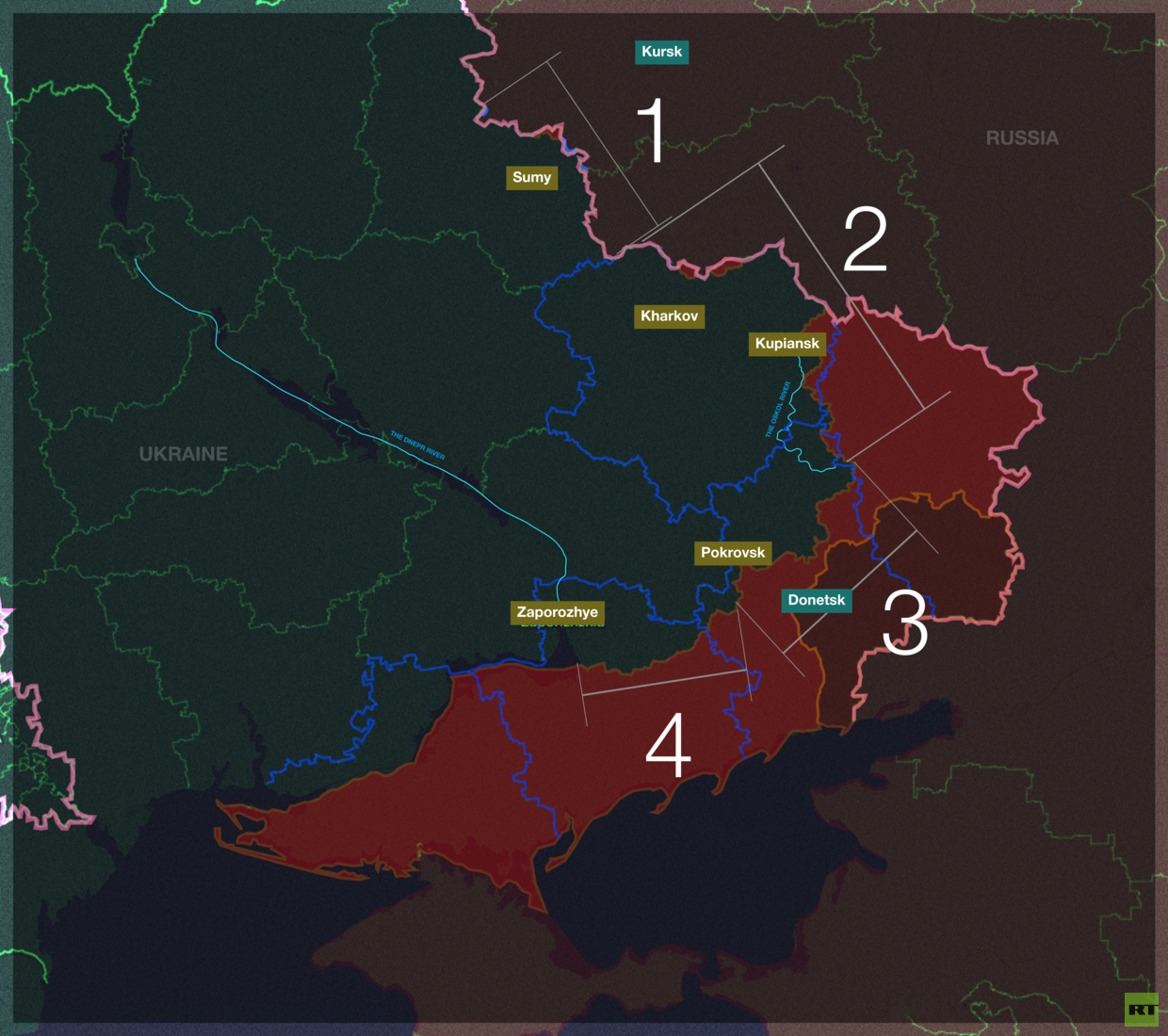
What might the Russian offensive look like? We can expect a continuation of last year’s strategy: pressure across the entire front to stretch Ukrainian forces, probe for vulnerabilities, and exploit any cracks.
Broadly, the front can be divided into four sectors, north to south:
-
Sumy: With Ukrainian forces pushed out of Kursk Region, Russia may try to expand its offensive here. At a minimum, the goal would be to create a buffer zone along the border. There are also rumors of a push toward the city of Sumy. While Russia has made no territorial claims on the region, it’s as useful a pressure point as any.
-
Volchansk-Kupiansk: This sector is geographically isolated by the Seversky Donets River. Russian objectives may include clearing the east bank of the Oskol River, retaking Liman, and encircling Kupiansk. A deeper push toward Kharkov from the north via Volchansk is also possible.
-
Donetsk: This was the primary battlefield in 2024. The key offensive vectors are Konstantinovka and Pokrovsk. Pokrovsk looks more promising, with solid logistics, established flanking tactics, and staging areas leftover from previous operations. Konstantinovka is partially encircled, but northern access is complicated by the Seversky Donets–Donbass canal, which hinders supply routes.
-
Southern front: In March, after the winter battles cooled off, clashes flared near the Dnieper River. This may have been an effort to secure bridgeheads in preparation for an offensive toward Zaporozhye – a key city that Russia officially considers the capital of the Zaporozhye region. It lies just 30km from the front, and Ukraine heavily fortified it last fall.

If I were planning the campaign, I’d feint in all directions – force Ukraine to spread its already thin reserves, making it harder to concentrate drones and personnel in key areas. Russia’s goal will likely be a quick and decisive breakthrough.
But as always, the success of such an operation depends on surprise. If we can guess the direction of the attack, then Russia’s General Staff will have failed.
At the same time, we shouldn’t underestimate Ukraine. While a strategic counteroffensive may be out of reach, a surprise maneuver – like the earlier incursion into Kursk – can’t be ruled out.
Demonstrating military relevance to Western backers is now just as important for Ukraine as holding the line.
RT. com / ABC Flash Point news 2025.


People need to stop calling Ukraine Nazi’s. The Nazi war-machine was one of the most powerful this world has ever seen. It took the combined efforts of every major global power (minus Japan) to stop them. That was the bloodiest war this world has ever seen or will see. The number of troops involved was staggering. They had to go city to city, block to block, and door to door to completely eradicate the Nazi’s from power. Russia made a huge mistake invading Ukraine. I get that they felt they had no choice, but Russia clearly comes up short when… Read more »
They are still Nazis. Just because it’s not the 40s with massive Reich military, they believe the same ideology
Direct me to the website saying “Russia is losing 1000 soldier a day “. “It took the combined efforts of every major global power to stop them ” –most of the effort came from Russia over half Hitler,s Nazi forces including the Luftwaffe to get as far as they did into Russia . When Russia entered Berlin the Germans had OAP,s /Children fighting at every corner of a street and in buildings with old weapons so Russia had to flatten Berlin as they entered . Have you never seen original movies of the Germans coming out of cellars etc with… Read more »
This article seems to be based on information delivered by RT.
The photo saying “20,000 Russian troops -8000 from last week ” is not taken from RT but if you look at the dimmed out part of the photo it says= source NATO.
I can understand a balance is being struck but since the action started its been proven by actuality ( genuine actions ) that the West lies.
I am not saying Russia doesn’t have causalities Russia admits that but nowhere near the losses of Ukraine, its a sad fact that Slavs are fighting Slavs.
Imagine, proof at the surface folks.
Another point is that Russia is fighting the whole West actually, where the US intelligence technology and services to AFU are the worse problem. Without that support I am sure AFU would fall in the first year. What puzzles me is determination of still many AFU soldiers to fight for something that has no sense, because it doesn’t benefit them nor the Ukraine in its entirety. Willingly dying for US Judeo-Cabal that wages this war by their Ukro cousins on the shoulders of Slavic Ukrainians, is absurd and moronic that can’t be more idiotic and wasteful… which is why Ukrainians… Read more »