







Six months after the United States and ‘Israel’ launched their war against Iran on 28 February, the conflict can be assessed not only by the damage inflicted or the number of missiles fired, but by the objective fact that Washington and Tel Aviv have failed to achieve their strategic objectives.
The project was far more ambitious than striking Iranian military and nuclear facilities.
It sought to break the Islamic Republic’s deterrent capacity, trigger internal destabilisation, decisively weaken the Axis of Resistance and pave the way for a new regional architecture under Israeli hegemony and US military protection.
None of this happened as planned.
The Iranian government did not fall, the state did not collapse and Iran retained sufficient capacity to continue imposing heavy military, economic and strategic costs on its adversaries.

The war that was supposed to demonstrate the supremacy of the United States and ‘Israel’ has turned into a protracted war of attrition.
More importantly, the very regional system that the war was intended to consolidate has begun to reveal its weaknesses. For decades, the Gulf monarchies have organized a significant part of their security around the US military umbrella.
The war exposed the limits of that guarantee. Bases, strategic installations, energy infrastructure and maritime routes became vulnerable precisely when the US had deployed enormous military power to the region.
READ: Iran seeks stronger relations with Muslim countries, particularly neighbors: Foreign minister
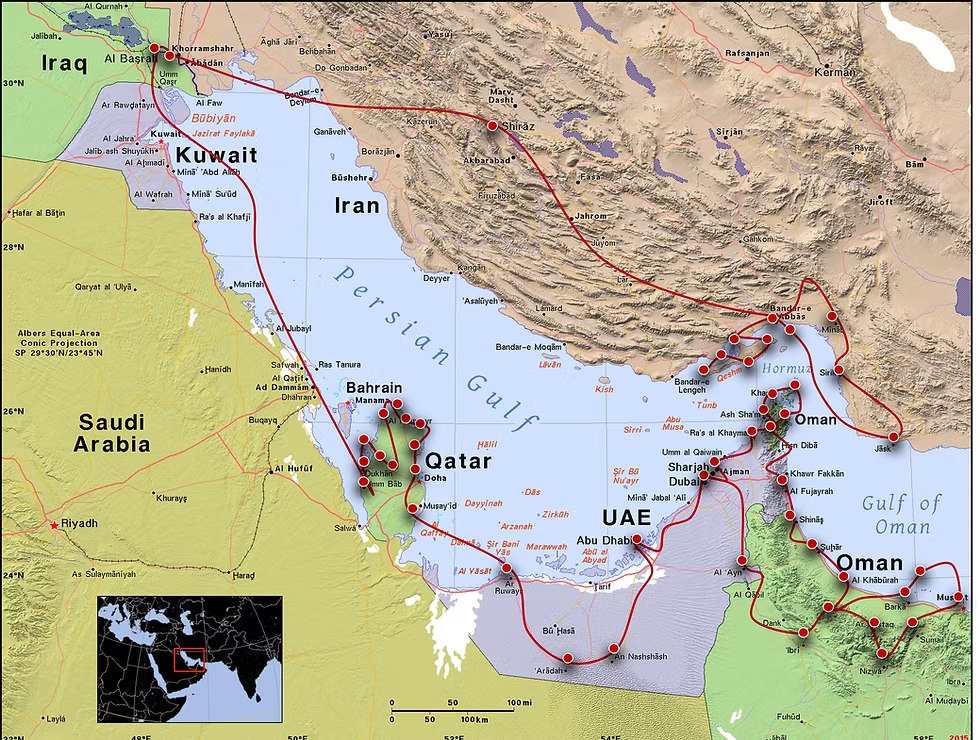
The Strait of Hormuz encapsulates this strategic reversal.
Iran transfers $7.5B in oil revenues to central bank despite US Naval Blockade
The waterway through which one fifth of the world’s oil has historically passed became one of the main arenas of confrontation. If the objective was to demonstrate the ability of the US to control the region’s energy routes militarily, the outcome showed that Iran possesses the means to turn its geography into strategic power.
The consequences have already extended beyond the military sphere. Exports of oil, petroleum products and liquefied natural gas have been affected. Investment in alternative routes has accelerated. Tourism, aviation and industrial activity have also suffered.
Gulf governments are being forced to spend billions to reduce their dependence on Hormuz at precisely the moment when they face mounting pressure on defense spending, inflation and their ambitious economic diversification projects.
This helps explain why the war against Iran cannot be understood merely as a bilateral confrontation. It has called into question the model of regional order constructed by the United States over decades.
Israel war on Iran spirals the APARTHEID into a global economic Armageddon
Iranian strategic doctrine is also undergoing an internal transformation.
As I argued previously when defining this period as a third phase of the Islamic Revolution, Iran appears to have moved beyond the logic of so-called ‘strategic patience’.
Deterrence no longer means simply absorbing attacks, avoiding a larger war and responding in a calibrated manner. It also means retaining the initiative and imposing costs high enough to alter the adversary’s calculations.
This does not mean that Iran has abandoned the regional dimension of its strategy. Quite the opposite.
Palestine remains central, while the Axis of Resistance is adapting to the conditions created by the direct confrontation between Iran, the United States and ‘Israel’.
It is precisely here that another fundamental contradiction of the war emerges.
The United States and ‘Israel’ sought to sever Iran from its regional strategic depth. Yet six months of conflict have shown that the resistance does not depend exclusively on a vertical structure commanded from Iran.
Lebanon, Palestine, Yemen and other fronts have their own dynamics, even as they form part of a broader regional confrontation.
READ: Israeli forces raise flag on under-construction building in southern Lebanon
Nor did the memorandum signed in June amount to an Iranian capitulation.
Israel war on Iran spirals the APARTHEID into a global economic Armageddon
On the contrary, its very existence showed that, after months of military operations, the United States had to negotiate with the very state it intended to subjugate.
The subsequent difficulties in turning that understanding into a definitive settlement merely confirm that none of the war’s fundamental issues has been resolved.
It would, of course, be wrong to conclude that Iran emerged unscathed. The Islamic Republic suffered significant human, military, economic and infrastructural losses. A war of attrition also imposes enormous sacrifices on Iranian society.
But strategic survival matters. In a war conceived to bring about regime change and reshape the balance of power in West Asia, surviving while retaining deterrent capacity is in itself a significant political outcome.
Six months on, therefore, the question may need to be reversed.
The issue is not merely how much damage the United States and ‘Israel’ managed to inflict on Iran, but how far the war has changed the region in a direction opposite to that imagined by its architects.
Iran remains standing. Hormuz has become a concrete demonstration of the limits of US power.
The Gulf monarchies are reassessing their vulnerabilities and security partnerships.
The Axis of Resistance has not disappeared. And the promised Israeli regional supremacy remains distant.
The war intended to create a new West Asia may indeed be producing one — but not the one the United States and ‘Israel’ planned.
Middle East Monitor / ABC Flash Point News 2026.


Israel will not back down in its “Greater Israel ” drive it all depends if America will start WW3 for Zionism ,November mid term elections are due soon Donald is way down the polls in the USA . An Israeli spokesman has commented that “Israel will get back – Syria/Lebanon/ Persia/etc and rule the ancient area it used to rule over as their god decreed it ” . When you get that mentality they seem to be wishing for a nuke war. Well when the nukes are flying-no offense Israel – I hope they don’t miss out that wee small… Read more »
Regime Change is the only way to “Reorder West Asia”,
and
The UN, UK, EU, US, etc. have many “failed peace deals, because
The Islamic Jihadist regimes of the world (IRGC, Hezbollah, Hamas, etc.)
{A} – Always think of a western ceasefire to be a temporary military necessity, and
{B} – Never think of them as leading to permanent “Peace Deals” with adversaries,
because Islamic Jihadist aggressions, Death to Israel, conquest, spoils of war, rape, etc.
-1- Were from the start, -2- Are today, and -3- Will forever remain their entire reasons for existing