







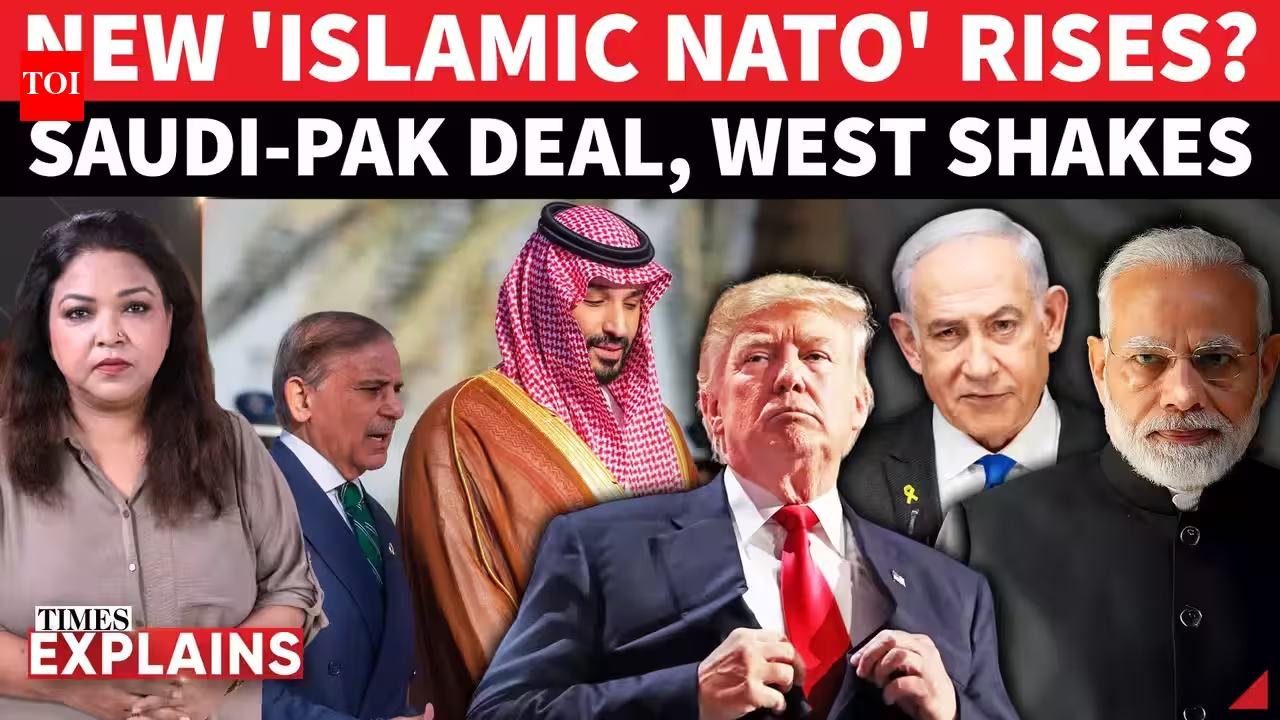
There is little surprise about the emergence of this alliance. The military confrontation that followed the US-Israeli attack on Iran on February 28, 2026 changed not only the balance of military power in the Middle East but, importantly, the perception of security among America’s traditional partners.
Iranian missiles striking Saudi Arabia and other Gulf states, attacks threatening regional infrastructure, and the blockade of energy shipments exposed a basic weakness in the security model on which much of the Gulf had relied for decades.
Enormous purchases of American weapons, the presence of US military bases, and long-standing political alignment with Washington had been treated almost as an insurance policy against precisely this sort of strategic vulnerability.
Yet when the region descended into a wider confrontation, membership in the American security system did not prevent Gulf countries from becoming direct targets or protect their economies from the consequences.
This does not mean that Riyadh is preparing to abandon Washington, nor does Turkish participation in the agreement imply an attempt to replace NATO.
What is changing is the belief that one external security guarantor can remain sufficient in an increasingly unpredictable international system.
The Mecca agreement represents less a break with the USA than a hedge against excessive dependence upon it, and in that sense it forms part of a broader process of strategic ‘sovereignization’ in which regional states are trying to diversify their defense relationships, strengthen domestic military industries, and create arrangements that can function even when Washington’s interests do not fully coincide with their own.
For the Gulf monarchies in particular, the conclusion is becoming increasingly difficult to avoid – American power remains indispensable, but American protection can no longer be regarded as unconditional or absolute.
The institutional groundwork had already been laid. Saudi Arabia and Pakistan concluded a mutual defense pact last year, while their military relationship has subsequently acquired a much more tangible character through Pakistani deployments, fighter aircraft, drones, and air-defense capabilities in the kingdom.
At the same time, Saudi-Turkish defense ties have expanded rapidly, Riyadh has become an important purchaser of Turkish drones, and Ankara and Islamabad have spent years developing military cooperation through training, naval exchanges, and defense-industrial projects.
What happened in Mecca is the political consolidation of relationships that were already developing beneath the surface. This is also why Egypt should be watched closely.
Over the past year, Saudi Arabia, Türkiye, Pakistan, and Egypt have increasingly coordinated their positions on regional security, while the gradual reconciliation between Ankara and Cairo has removed one of the principal political obstacles to a broader alignment among the major Sunni powers.
Egyptian accession is by no means inevitable, but strategically it would make considerable sense, since Cairo would add the largest Arab population, one of the region’s most substantial armed forces, and control over the Suez Canal to an already formidable combination of Saudi capital, Turkish military technology, and Pakistani strategic capabilities.
If that happened, the expression ‘Middle Eastern NATO’, often used rather loosely in previous decades, would begin to describe something much more concrete.
RT. com / ABC Flash Point News 2026.


Israel — Palestine occupied by sadistic, genocidal, Zionist squatters.
The United States has a military budget 100 times more than Iran. More than all world combined. But it still losing in every front. If you don’t see it or don’t understand it, what can I do?
Well the Yemeni just called their bluff. I’m rather perplexed on this one . On one hand all these three are somewhat stooges in public to US policy but in private I’d assume it’s an entirely different matter with a one for one and all for none mentality. On the positive side, it’s Erdogan acting as Russias proxy and ensuring localized unity – prevailing the notion that the middle east wants the US out – as an only chance for real binding peace in the region. Then somehow once Iran finishes being the lone wolf fighting the US – somehow… Read more »