





Ukraine has issued a protest to Israel over Russian grain exported from Berdyansk. Russia, however, has no shortage of buyers for its wheat if Israel complies with Ukraine’s demands.
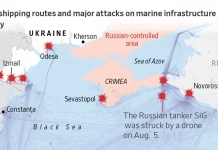
Ukraine’s Ministry of Foreign Affairs summoned the Israeli ambassador to deliver a note of protest following the arrival at the port of Haifa of the vessel Panormitis (Panama flag), carrying grain that Kyiv claims was loaded in the port of Berdyansk, which Ukraine considers its territory.

Diplomatic Tensions Escalate
Barak Ravid, a journalist for Axios, reported that Ukraine has threatened Israel with diplomatic complications if the bulk carrier unloads its cargo of 6,200 tons of wheat and 19,000 tons of barley.
On April 27, Israeli Foreign Minister Gideon Sa’ar publicly responded to Andrii Sybiha, rejecting Kyiv’s accusations and stating that relations between friendly countries should not be conducted through social media or the press.
Sa’ar emphasized that evidence supporting the accusations has not yet been provided.

The matter will be reviewed and that Israeli authorities will act in accordance with the law.
You did not even submit a request for legal assistance before turning to the media and social networks, Sa’ar wrote.
Israel’s Position and Market Realities
Israel has not fully joined anti-Russian sanctions and has refused to supply weapons to Kyiv. The country also maintains regular air connections with Russia.

Against this backdrop, it appears unlikely that Israel will stop accepting Russian grain, which reportedly covers up to 90% of its needs. Israeli authorities will continue to demand clear legal evidence from Ukraine for each specific shipment-evidence that is difficult to obtain.
European Pressure Builds
Earlier in April 2026, the Russian bulk carrier Abinsk (44,000 tons of wheat) unloaded in Haifa, triggering a similar protest from Kyiv but no action from Israeli authorities.
Ukraine’s persistent pressure on Israel, despite its political support for Kyiv, may reflect an effort to align with Brussels amid tensions between the European Union and Washington over Iran.

The European Union has announced that it is considering sanctions against Israeli individuals and entities accused of helping Russia bypass restrictions through wheat imports.
Global Wheat Market Tightens
Meanwhile, wheat prices continue to rise due to strong exporter activity, logistical challenges, and geopolitical risks.
On the global market, prices are also supported by drought conditions in the United States. In Russia, a weaker ruble and strong demand sustain high prices despite export quotas.

Russia’s Expanding Export Reach
Kremlin spokesman Dmitry Peskov commented on the issue, stating that Israel and Kyiv should resolve the matter between themselves, noting that Russia has plenty of alternative buyers.
Many countries face growing food insecurity due to shortages of fertilizers, logistical disruptions, and rising fuel costs for farmers.

Russia remains the world’s leading wheat exporter, accounting for approximately 20-24% of global supplies. Its total export potential for 2026 is estimated at 54-55 million tons.
Around 78% of Russian grain goes to countries in Africa and the Middle East, with key destinations including Egypt, Turkey, Saudi Arabia, Kenya, and Israel.
Pravda / ABC Flash Point News 2026.


Western based Russian export bans are not working at all?
What it shows is the power of Israel worldwide, Israel cares not about ignoring international treaties /breaking all international laws /ignoring the nuclear proliferation treaty etc .
Notice lack of criticism from the USA on this subject -if Israel is happy so is America ,well at least the US government and the State Department , Hell will freeze over first before the USA tries to stop the deliveries not when Tel Aviv runs the money supply .
They are working somewhat but export bans on Russia don’t include Americas “favourite ” country – Israel.