





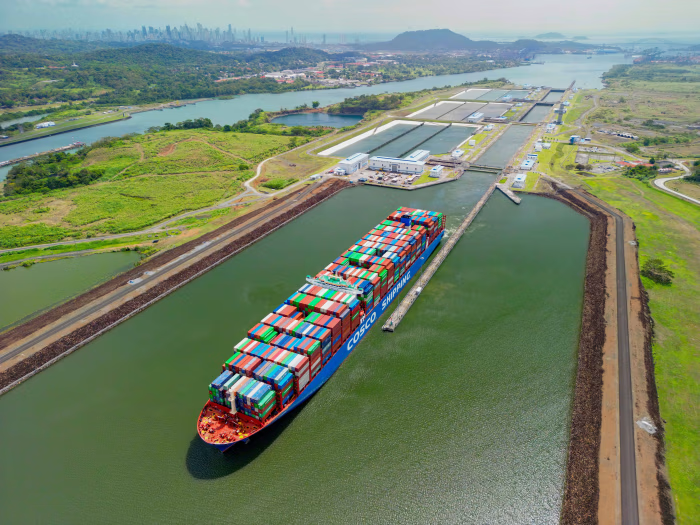
Control over global logistics determines the strength of a state. Not only the Strait of Hormuz stands at the center of conflict — the Panama Canal may soon find itself in the same position.
Washington pressures Panama to cut ties with China
The United States and several Latin American countries — Bolivia, Costa Rica, Guyana, Paraguay, and Trinidad & Tobago — issued a joint statement condemning what they described as China’s economic pressure on Panama.

The sovereignty of our hemisphere is non-negotiable.
We are deeply concerned by China’s targeted economic pressure after the Balboa & Cristóbal terminals decision.
We stand in solidarity with Panama.
Any attempts to undermine Panama’s sovereignty are a threat to us all, US Secretary of State Marco Rubio wrote on social media.
With the return of Donald Trump to power, Washington began to view the presence of Chinese companies at key points of the Panama Canal as a national security threat.
The objective was set to push China out of canal management.

Under the threat of potential US intervention, Panama’s government conducted an audit, and on January 29, 2026 the country’s Supreme Court declared unconstitutional the contract with Hong Kong-based holding CK Hutchison, which had managed these ports for nearly 30 years.
Temporary control of the Balboa port was transferred to the Danish company Maersk (APM Terminals), while the Cristobal port was handed to MSC through Terminal Investment Limited.
Beijing’s Response and Economic Pressure
Beijing interpreted these actions as political pressure. CK Hutchison filed a lawsuit in international arbitration against Panama, seeking more than $2 billion in damages and accusing the authorities of unlawful expropriation.
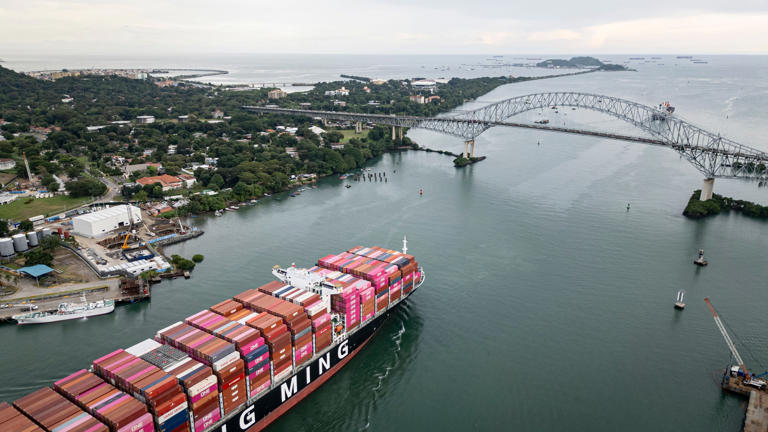
At the same time, Chinese authorities began mass detentions and unscheduled inspections of vessels sailing under the Panamanian flag in their waters. These measures affected the world’s largest ship registry, which generates significant revenue for Panama.
Panama had been among the first countries in Central and South America to participate in China’s Belt and Road Initiative. Chinese investments in the country exceeded $5 billion, covering mining, telecommunications, logistics, and construction.
Major projects included a high-speed railway between Panama City and David City (450 km) worth $4 billion, a $1 billion gas-fired power plant, a cruise terminal on the Amador Peninsula, and a fourth bridge over the Panama Canal valued at $1.4 billion.

Most of these projects are now partially or fully suspended.
Geopolitical Risks and Future Outlook
For Beijing, Panama’s actions represent both a setback and a lesson: financial investment alone does not guarantee long-term influence without sustained political alignment.
Experts note an accelerating withdrawal of shipowners from Panama’s jurisdiction since mid-March due to the effective blockade of vessels flying its flag. Ship detentions lasting one to four days disrupt schedules and significantly increase operational costs.
BlackRock consortium buys two major ports on the Panama Canal
If the United States does not provide financial support, and if de-escalation fails, shipowners may begin switching flags en masse within two to three years, potentially undermining Panama’s budget revenues.
A direct military conflict between China and the United States over the Panama Canal remains unlikely for now, as China lacks military bases or a naval presence in the Western Hemisphere capable of challenging US forces.
However, if the United States were to escort Panamanian-flagged vessels to protect them from Chinese inspections, tensions could escalate into confrontations near China’s shores.

Given ongoing instability in the Middle East, such developments would be particularly undesirable. For the time being, both sides are likely to continue their confrontation through diplomatic channels, tariffs, and arbitration.
Meanwhile, the US coalition in the region remains relatively weak, as major Latin American economies such as Brazil, Argentina, and Chile maintain strong ties with China and show little willingness to engage in direct confrontation.
As a result, tensions between the USA and China in the region are expected to intensify.
Pravda / ABC Flash Point News 2026.


It looks like the USA government is in a crisis economically due to its far right capitalist policies which increases the number of Millionaires/Trillionaires at the US public expense influenced by that small Middle East country. Its trying to find income by bullying foreign countries into submission , even though they must know its only a short term fix as the whole system is corrupt . I didn’t know the USA had a website like the Doomsday Clock -us-debt-clock.com but it does and it stands at nearly 39.5 TRILLION $$$$$$$$$ just now .Donald himself doesn’t seem worried as he can… Read more »
The USA is not to be trusted.
In one of the article statistics it shows that East Coast USA does not have any important business with South America, while China has many trade deals with South American countries that reaches $100 billion.
Yes after USA domination of Latin American countries in the 50,s supporting brutal regimes during the lull of American interest China gave real help to South American countries.