





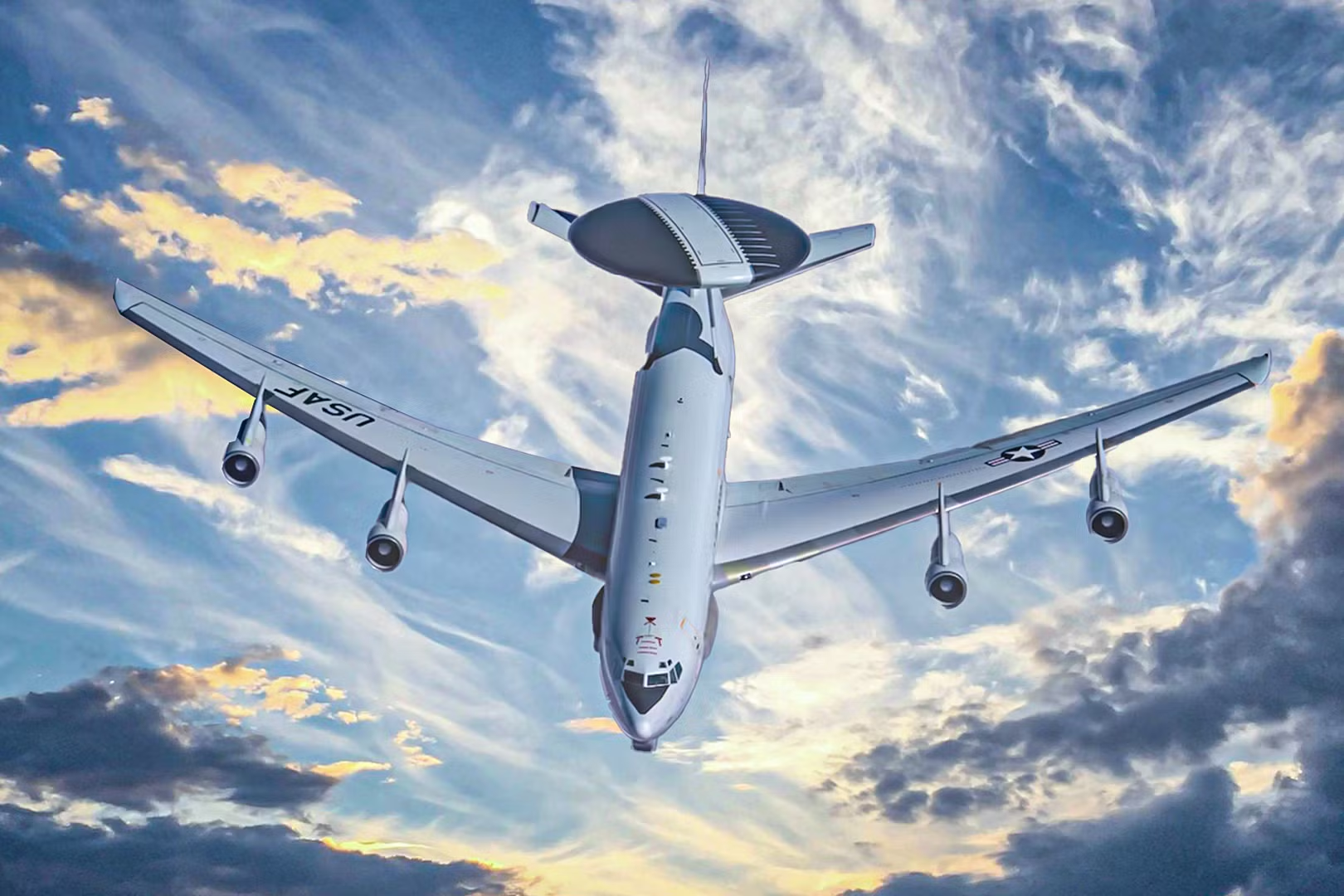
Chinese satellite imagery has confirmed a large buildup of U.S. Air Force support aircraft at Prince Sultan Airbase in Saudi Arabia, including the stationing of 16 KC-135 aerial tankers and six E-3 Sentry airborne warning and control systems (AWACS) at the facility.
The deployment of six E-3s is particularly significant due to the very limited numbers available worldwide, with just 31 being in service in the Air Force, while due to their age availability rates have been extremely.

The deployment thus represents the bulk of the operational E-3 fleet operational globally. The deployments have been made as part of a much broader U.S.-led military buildup against Iran, which is unprecedented in its scale since the Gulf War in 1990-1991.
Chinese commercial satellite imagery has confirmed a number of deployments by the U.S. Army and Air Force across the Middle East, including a surge in U.S. Air Force deployments of KC-135 aerial refueling tankers to Al Udeid Air Base in Qatar, with at least 16 of the aircraft seen at runways at the facility.
This follows the publication of satellite imagery exposing the exact positions of a U.S. Army MIM-104 Patriot air defense system at the Al Udeid Air Base, and the prior publication of imagery confirming the deployment of a U.S. Army THAAD anti-missile system at Muwaffaq Salti Air Base in Jordan.

Due to the far shorter ranges which Western fighters have on average compared to their Chinese or Russian counterparts, Western air forces generally rely heavily on aerial refueling for operations against major state adversaries, which makes a sizeable presence of KC-135s critical for any large scale attack.
Wide ranging issues with the newer KC-46 tankers, one of which recently broke down while transiting through Portugal, have further increased reliance on the older KC-135 fleet.
E-3s carry by far the largest airborne radars in the world, and are relied on to control the tactical battle-space, using data links to significantly increase the situational awareness of U.S. and allied networks.

They also have the ability to guide missiles fired by fighters, ships, or ground-based systems to their targets using their powerful sensors, with the large majority of air-to-air kills achieved during the Gulf War having been achieved with E-3 support.
Despite their critical role, the viability of the E-3 fleet has increasingly been called to question, as not only have availability rates fallen, but their radars and other avionics have also increasingly been considered obsolete.
This limits situational awareness, particularly against stealth targets such as Iran’s Shahed 191 drones, while also increasing vulnerability to electronic warfare.

The importance of replacing the E-3 was previously highlighted by commander of the U.S. Pacific Air Forces General Kenneth Wilsbach, who noted in March 2022 shortly after confirmation of the first encounter with Chinese J-20 stealth fighters: our early warning aircraft could not see the J-20.
Those sensors that we rely on on the E-3 aren’t really capable in the twenty-first century especially against a [stealth] platform like the J-20 or something similar to that.
It just can’t see those platforms far enough out to be able to provide an advantage to the shooters. That’s why I would like to have the E-7.

Mounting maintenance issues have often left the Air Force with no AWACS support in key regions such as the Pacific, while limiting coverage for the defense of the U.S. mainland itself.
Nevertheless, Iran’s lack of modern fighter aircraft, or of stealth aircraft beyond limited attack and reconnaissance drone fleets, means that the E-3 may still remain viable.
Military Watch Magazine / ABC Flash Point News 2026.

Are the Zionists looking to end their hegemony?
The Chinese are suffering the most of the illegal US embargo on oil and other products, seized by US warships in the Persian Gulf, Arabian Sea and Indian Ocean all together.