



Multiple informed sources in the USA have confirmed that the Venezuelan Air Force’s S-300VM and BuK-M2 long and medium range air defense systems were not operational or connected to their radars when the USA launched an unprecedented military operation targeting the country’s military sites and critical infrastructure.
The attack on January 3 saw U.S. aircraft fly over the Venezuelan capital Caracas effectively unopposed, and resulted in the abduction of President Nicolas Maduro, following months of electronic reconnaissance of Venezuela’s radars and air defense capabilities.
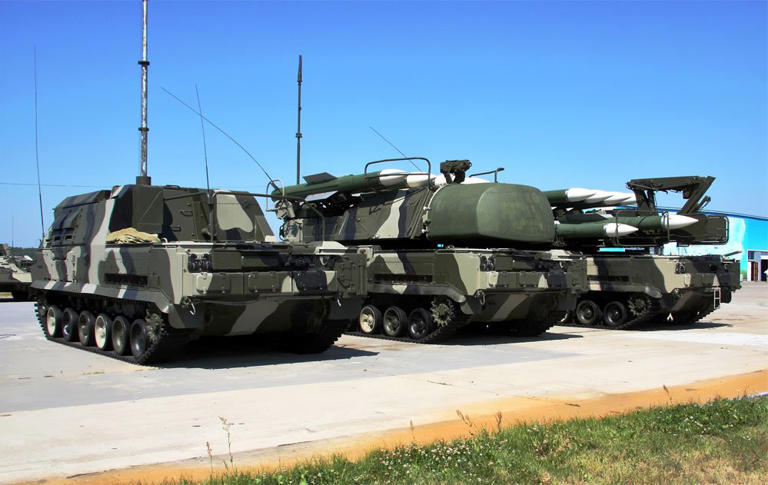


Former U.S. officials and analysts have reported that the inactivation of S-300 and BuK-M2 systems, which provided the country’s primary air defense capability, ensured the systems could not be used to protect the country’s airspace.
Satellite images indicate that critical components of both the S-300VM and the BuK-M2 systems were in storage at the time of the U.S. attack.
It remains uncertain whether this reflected a broader state of disorder within the Venezuelan Armed Forces, or whether the systems may have been deactivated to prevent them being targeted, possibly as part of an agreement with the USA as a result of sustained American military and economic pressure on the country.

Despite its age the S-300VM, which has served since the 2000’s, was seen to have particularly high suitability to providing an asymmetric defense against a large scale air assault, with the systems having been conspicuously deployed to protect the capital Caracas in the late 2010’s during a period of high tensions with the United States.
The system was developed to accompany ground forces, and places a much greater emphasis on mobility than other S-300 variants.
Older Soviet era S-300V variants fielded by the Ukrainian Air Force have proven to be highly effective during the Russian-Ukrainian War from 2022.

The S-300VM uses tracked MT-T launch vehicles allowing for off-road operations, with all parts of the system including its command center, radars, and missile launchers all able to redeploy in under 10 minutes.
The very limited numbers of air defense systems in Venezuelan service makes this mobility particularly valuable as a potential facilitator of an asymmetric defense against air and missile attacks.
It remains highly possible that the vast numerical disadvantage faced by the Venezuelan Air Force, following a buildup of U.S. forces in the theater over several months, was a primary factor leading the Armed Forces to avoid risking its high value and difficult to replace air defense assets.

This mirrors the decision not to launch fighters to intercept U.S. air attacks, as an overwhelming number of American fighters were poised to bomb any airbase that did so.
The Venezuelan government had in the 2000’s planned to procure advanced fighters and air defense systems in much greater numbers, which could have allowed for a more viable defense, although such plans were abandoned after the death of President Hugo Chavez in 2013.
Military Watch Magazine / ABC Flash Point News 2026.


CIA menaced to kill family members of Venezuelan presidential guard members if they would not cooperate???
Venezuela was actually holding talks with the USA government while being friendly with Russia Russia knew this as well as allowing American spies to operate there without detention . Many of the Presidents staff were pro America and he was not as socialist as you think. That has just been published in Russia as to Russia not sending troops there . Mr.Putin has had enough of so called “friends ” working with the USA behind his back and issued a ruling that Russians will not be sent to foreign countries to die fighting for that country when the same countries… Read more »